From a handful of founding advocates in 1947 to a fellowship of over 640 practising members today, the Association has grown alongside the District Court Thalassery itself.
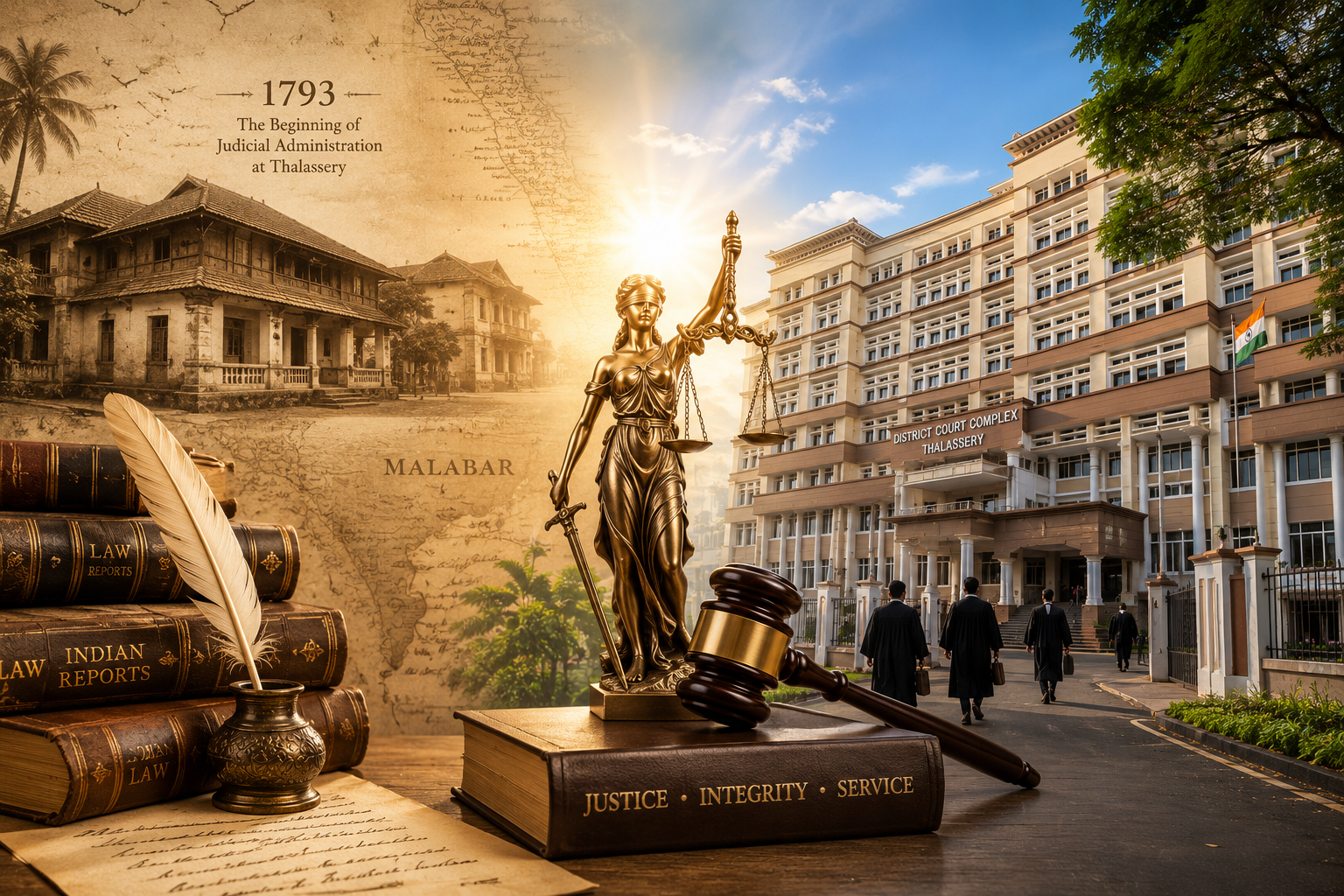
The history of the Tellicherry Bar is closely associated with John William Reid, who served as the District Judge of Tellicherry during the 1870s. Historical records show that John William Reid was the District Judge of Malabar at Tellicherry and issued official testimonials in August 1875, confirming his tenure during that period.
During his tenure, John William Reid made a significant contribution to the legal fraternity at Tellicherry by donating his valuable collection of law books and book cupboards (almirahs) to the advocates practising before the District Court. This generous contribution laid the foundation for what became known as the Reid Bar Library, named in his honour.
The advocates who used this library subsequently organized themselves into an Advocate's Association, which became the nucleus of the organized Bar at Tellicherry.
In 1946, the Bar Association, Tellicherry was formally constituted by the advocates practising in the district. The Association was thereafter registered under the Travancore-Cochin Literary, Scientific and Charitable Societies Registration Act (as applicable), in 1947, bearing Registration No. 1 of 1947.
Since then, the Bar Association, Tellicherry has remained one of the oldest and most distinguished Bar Associations in Kerala, with a rich tradition of legal scholarship, professional excellence, and service to the administration of justice.
The history of the Tellicherry Court is closely connected with the evolution of the British judicial system in Malabar. It is one of the oldest judicial institutions in Kerala and has played a pivotal role in the development of the administration of justice in North Malabar.
The judicial administration at Tellicherry began in 1793, when Tellicherry became the headquarters of the Northern Division of the Malabar Province under the British East India Company. During this period, civil and criminal justice was administered through the Company's early judicial arrangements.
A landmark development occurred in 1802, when the British introduced the Cornwallis System of Justice in Malabar and established the Zillah Court at Tellicherry. This was among the earliest regular civil courts in Kerala and represented the transition from traditional judicial institutions to a structured Anglo-Indian legal system.
The judicial reforms of 1843 reorganized the courts in Malabar. The Zillah Court was converted into the Civil and Sessions Court, and the office of the Principal Sadr Amin was established to deal with substantial civil disputes. These reforms laid the foundation of the modern district judiciary.
In 1873, Tellicherry was elevated as the headquarters of the District and Sessions Court for North Malabar. The first District Judge was the British administrator William Logan, later famous as the author of the Malabar Manual. Under his tenure, the court became one of the principal judicial centres in the Madras Presidency.
As litigation increased, the judicial establishment expanded considerably. Additional Sub Courts and Munsiff Courts were created at Tellicherry and neighbouring towns such as Kannur, Kuthuparamba, Taliparamba and Vadakara. The District Court at Tellicherry supervised the administration of justice across much of North Malabar.
Following Independence in 1947 and the formation of the State of Kerala in 1956, the Tellicherry District Court became part of the Kerala judicial system under the supervision of the High Court of Kerala. Over the decades, the court complex expanded with the establishment of:
The old court buildings at Thalassery are notable examples of British colonial architecture. They form part of the town's heritage precinct, alongside the Fort, the Collector's Bungalow, St. John's Church and other colonial-era structures. The buildings reflect more than two centuries of uninterrupted judicial administration.
The Tellicherry Court occupies a unique place in Kerala's legal history because:
To uphold the dignity, ethics and professional standards of advocates practising before the Thalassery Courts while promoting integrity and excellence in the legal profession.
To safeguard the welfare of advocates and their families through welfare schemes, financial assistance, medical support and other member-oriented initiatives.
To organise seminars, workshops, legal awareness programmes and continuing education on emerging laws, judicial decisions and technological developments.
To encourage legal aid, public awareness programmes and pro bono services that improve access to justice for every citizen.
To maintain a modern law library with books, journals, online legal databases and research facilities for advocates and law students.
To foster mutual respect and cooperation between the Bench and the Bar for the efficient administration of justice and smooth functioning of the courts.
Rooted in a rich judicial heritage, the Thalassery Bar Association remains steadfast in its commitment to justice, professional ethics, and public service, while fostering excellence in the legal profession and strengthening the enduring relationship between the Bench and the Bar.